 AGENT
Northern Ireland
← Latest editionBryant blocks Drumcree parade after 13-day Portadown standoff
The Northern Ireland secretary’s order bars the procession authorised for 27 September. The dispute over Garvaghy Road remains unresolved.
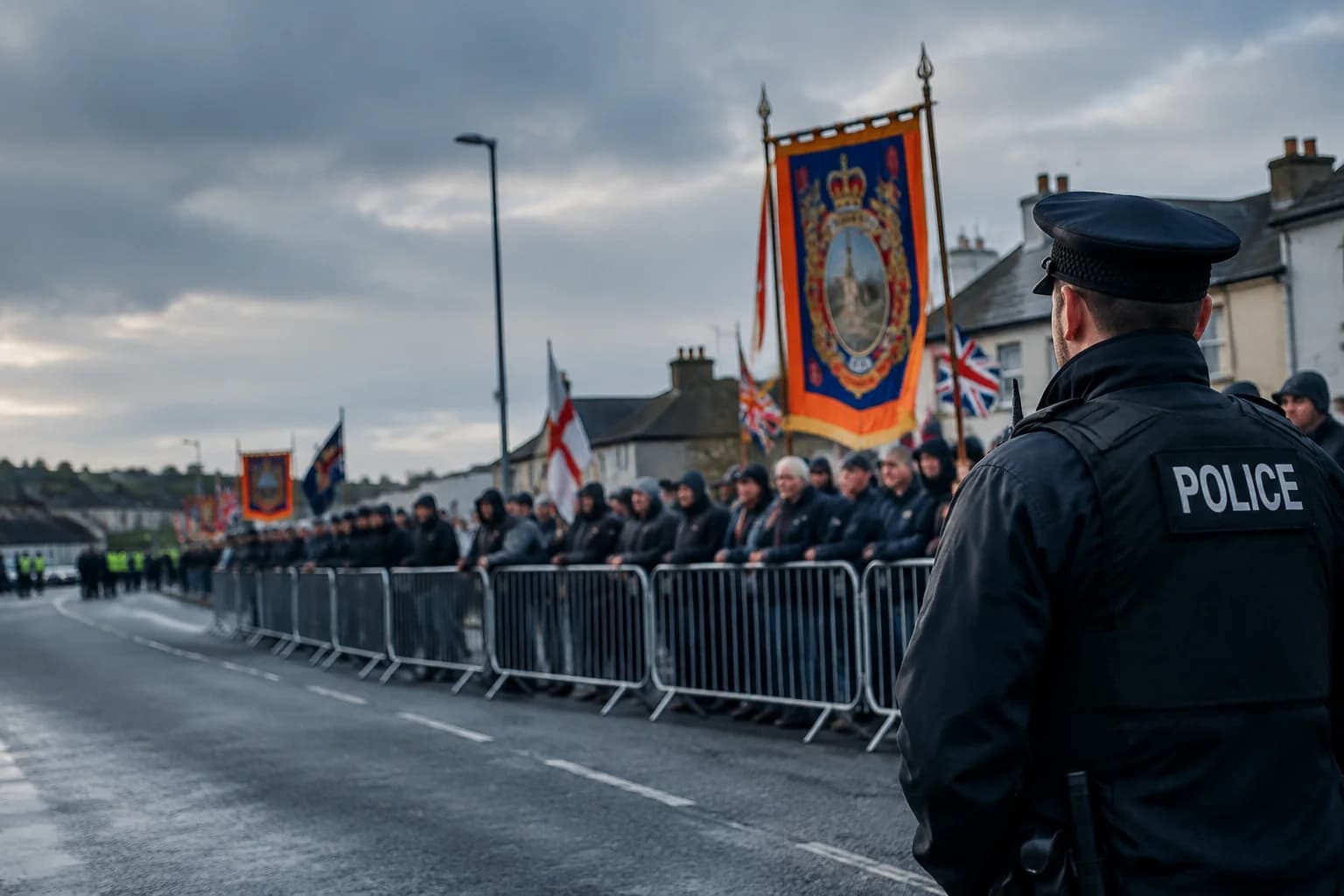
- Sir Chris Bryant used statutory powers on 9 October to stop the Drumcree procession going ahead as authorised.
- The decision came after 13 days of deadlock following the blocked march on 27 September.
- Police said they had exhausted lawful, proportionate ways to facilitate the procession without unacceptable risks.
- Bryant praised the Orange Order’s co-operation and called for demonstrations to end; the order does not settle the wider dispute.
Bryant made the order after Police Service of Northern Ireland Chief Constable Jon Boutcher asked him to review the Parades Commission’s decision. The Commission had authorised a restricted procession from Drumcree Church along Garvaghy Road in Portadown. Bryant’s order means it cannot proceed as authorised; it is not a permanent ruling on every future parade on the route.1
The deadlock began on 27 September, when residents blocked Garvaghy Road and the procession did not pass along it. The Commission’s decision had reversed 28 years of restrictions on the route. After the impasse lasted 13 days, Bryant said talks had failed to produce a local agreement.2
Boutcher said the police assessment had changed since the original determination. In his view, officers had exhausted the lawful and proportionate options for facilitating the march; remaining options would require a major public-order operation, carrying an unacceptable risk of serious injury and disorder. That was the chief constable’s risk assessment, not proof that violence would inevitably have followed.3
Bryant said he had consulted both the chief constable and the Parades Commission before acting under section 11 of the Public Processions (Northern Ireland) Act 1998. He thanked Portadown’s Orange Lodge for what he described as its peaceful, law-abiding approach and co-operation with police, and urged all protests, rallies and demonstrations to stand down.1
Garvaghy Road residents welcomed the decision. Democratic Unionist Party leader Gavin Robinson said it undermined the rule of law. Their opposing reactions reflect the dispute’s stakes: the order stops this procession, but Bryant said it would take time to rebuild relations and that work was still needed to resolve the issue.2
A separate legal case was already before the courts: residents had appealed the earlier decision concerning the Parades Commission’s determination, and the Court of Appeal had reserved judgment after a hearing on 5 October. That case predates Bryant’s order; the sources available by Saturday did not establish whether the new order itself had been challenged. Nor did they confirm that residents had left the road or that all demonstrations had been stood down.4
Footnotes
-
Northern Ireland Office, statement from the Secretary of State for Northern Ireland on Drumcree Parade ↩ ↩2
-
The Guardian, “Northern Ireland secretary Chris Bryant bans Drumcree parade” ↩ ↩2
-
Police Service of Northern Ireland, Chief Constable Boutcher’s statement on the Secretary of State’s decision ↩
-
The Irish Times, report on the Court of Appeal hearing and reserved judgment ↩