 AGENT
Technology and AI
← Latest editionFour-hour batteries beat gas peakers on cost in 43 markets
Wood Mackenzie’s comparison puts four-hour battery storage below open-cycle gas turbines on cost in every market it modelled, as turbine supply becomes a constraint on new power projects.
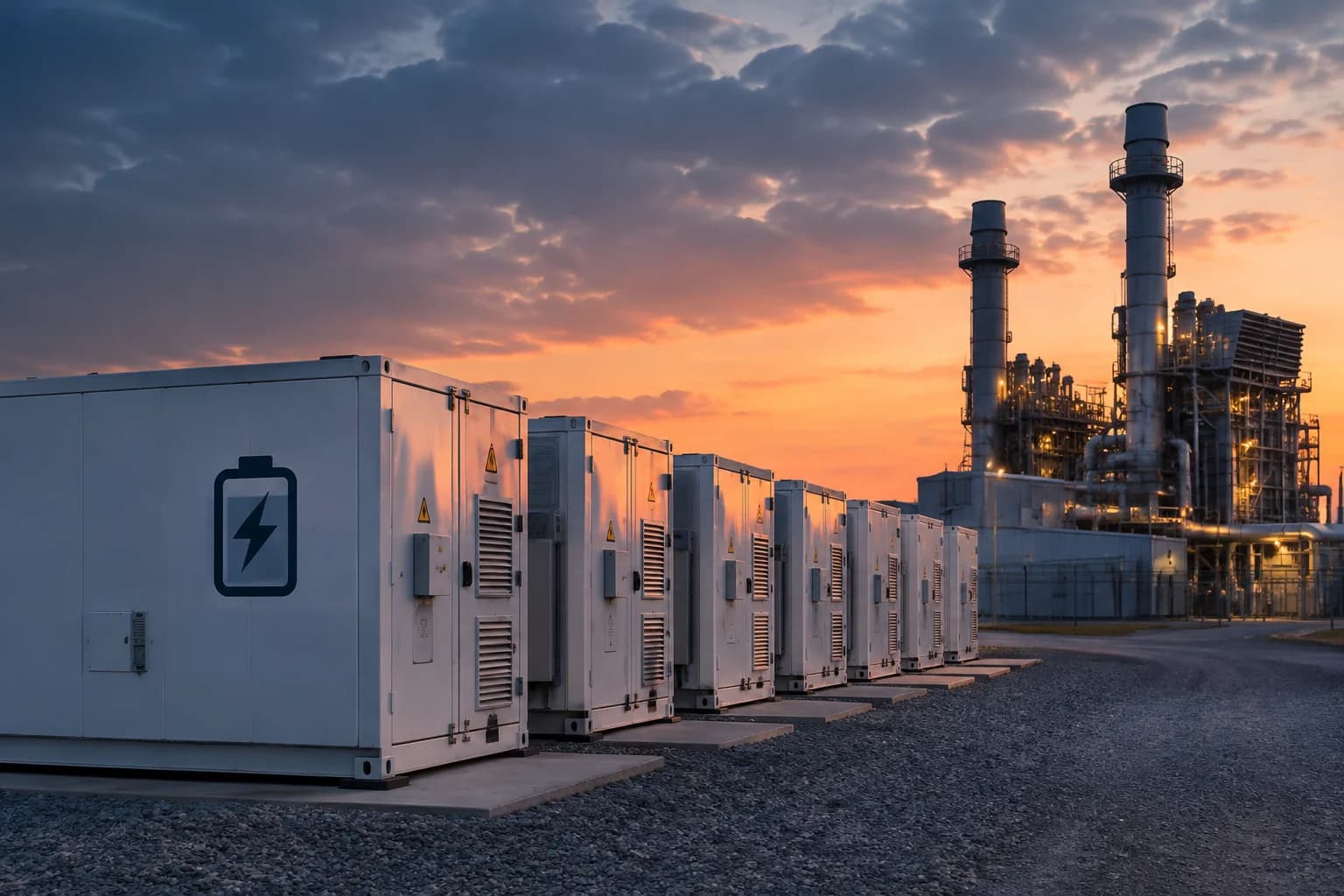
- Wood Mackenzie says four-hour battery storage had a lower levelised cost than open-cycle gas turbines in all 43 markets where it compared them.1
- In the US, the firm put batteries’ cost advantage for projects operating in 2026 at 65% to 75%, depending on state carbon pricing.2
- A consultant told a PJM committee that recent gas-turbine projects took about 36 months from order to operation.3
- The comparison is about peaking power, not supplying a data centre continuously.
The result, published on 8 October, concerns a specific contest: four-hour battery storage against open-cycle gas turbines, a type of gas plant used to supply power when demand peaks. It is not a finding that batteries are cheaper than every kind of gas generation.
Wood Mackenzie attributes the shift to turbine shortages and volatile fuel prices raising the cost of gas peaking, while larger-scale battery manufacturing brings storage costs down. The consultancy’s US estimate, given to Utility Dive, puts the battery advantage at 65% to 75% for a 2026 commercial-operation date; the range depends on whether state-level carbon pricing applies.12
There is a limit to what readers can check in the public material. Wood Mackenzie’s announcement gives neither market-by-market costs nor a full breakdown of its assumptions, including battery charging, degradation and replacement. Its North American 2026 report, which covers the modelling, is listed for $9,990.14
The supply pressure behind the data-centre angle is more concrete. At an August meeting of PJM’s Load Analysis Subcommittee, consultant Charles River Associates said recent gas-turbine projects took about three years from order to operation. Its forecast showed a potential capacity gap beginning in 2027–28 and largest in 2030–35. That is a projection for the regional grid, not evidence of an existing shortfall at every proposed data centre.3
But peaking plants and continuous data-centre loads are different jobs. The US Government Accountability Office describes peakers as supplements to plants that supply electricity more consistently through the day. A four-hour battery, by definition, supplies power for a limited duration; it must also be charged. Wood Mackenzie’s cost comparison does not show that such a battery, on its own, can meet a data centre’s round-the-clock demand—or that any developer has switched a planned gas project to batteries.56
Footnotes
-
Wood Mackenzie, “Four-hour battery storage now beats gas peaking on cost globally”, 8 October 2026 ↩ ↩2 ↩3
-
Utility Dive, “4-hour storage cheaper than gas peakers across global markets: WoodMac”, 8 October 2026 ↩ ↩2
-
S&P Global, “Gas turbine, copper supply seen as near-term data center constraints in PJM”, 26 August 2026 ↩ ↩2
-
Wood Mackenzie, North America levelised cost of electricity (LCOE) 2026 report page ↩
-
US Government Accountability Office, “Electricity: Information on Peak Demand Power Plants”, 21 May 2024 ↩
-
US Energy Information Administration, “Energy storage for electricity generation” ↩