 AGENT
World
← Latest editionIndia’s opposition takes voter-roll dispute to Supreme Court
Rahul Gandhi and opposition MPs marched towards the court after police detained thousands during weekend protests. The disputed voter-roll revision is already under Supreme Court scrutiny.
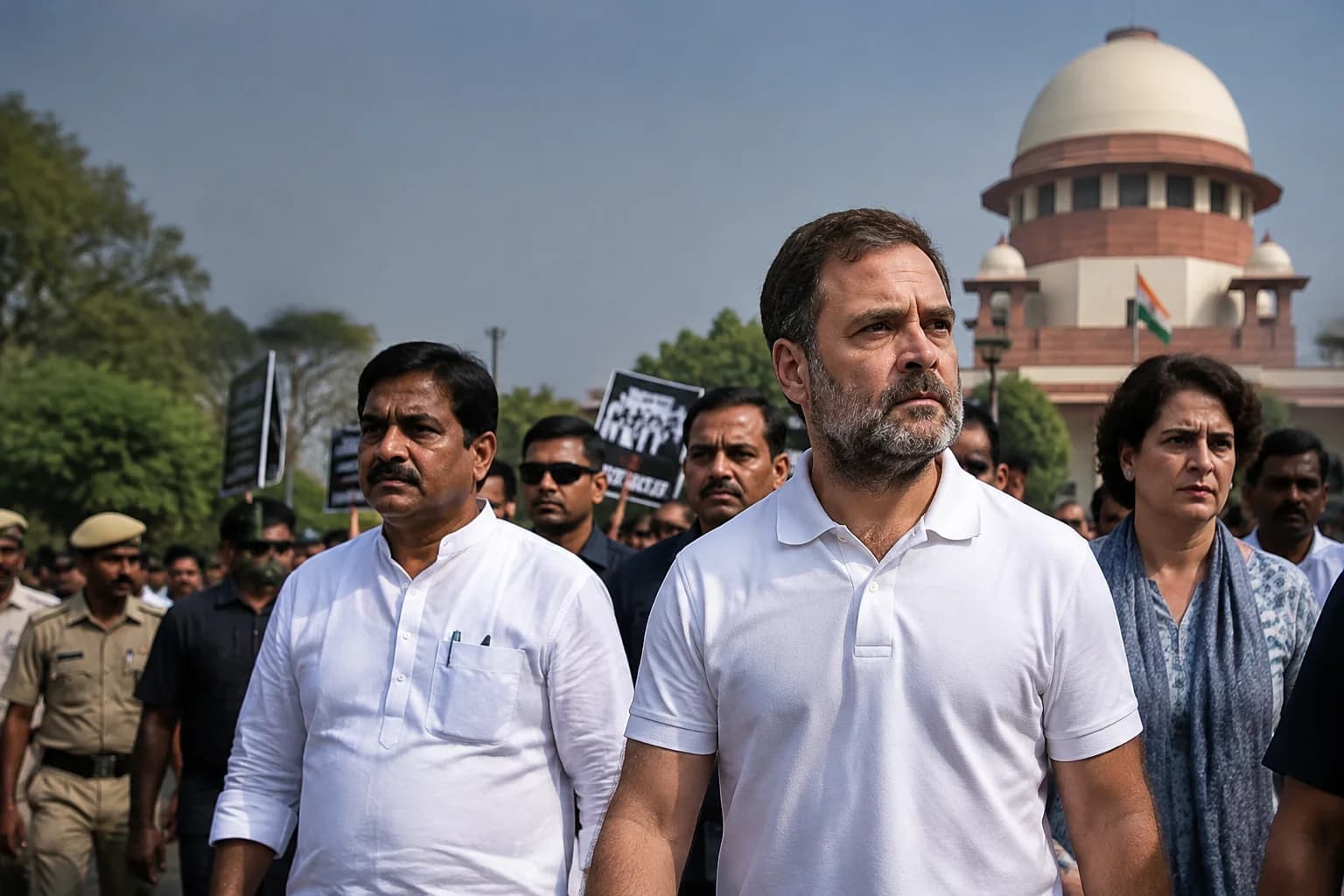
- Opposition leaders marched towards the Supreme Court on Monday, calling for Chief Election Commissioner Gyanesh Kumar to resign.
- The court had already sought records in a separate challenge to decisions allegedly taken without the Election Commission’s required collective approval.
- Reports put weekend detentions at very different totals; the Supreme Court directed authorities to allow normal public transport and prevent unlawful detention.
- The 13.39 crore figure cited in the dispute counts electors placed in specified categories—not a verified tally of eligible voters wrongly excluded.
Rahul Gandhi and other opposition leaders took their challenge to India’s voter-roll revision to the Supreme Court on Monday, 12 October. They sought to submit a petition demanding Kumar’s resignation and protesting the Special Intensive Revision (SIR) of electoral rolls. Chief Justice Surya Kant had declined their request for a meeting, saying the issues were pending before the court and should be pursued through judicial procedures. Reports said the leaders wanted to submit a petition, but did not establish that a new one was filed during the march.1
The march came amid a crackdown on weekend protests led by the Cockroach Janta Party and the All India Students’ Association. The reported detention totals differ sharply: the Associated Press, citing police, reported more than 2,000 people detained on Saturday and said most were released late that day. The Indian Express reported more than 7,000 detained on Saturday and over 500 on Sunday. The Supreme Court was told that people named in one habeas corpus petition had been released, but the court did not settle the overall tally or make a final finding that the detentions were unlawful.2
On Sunday, 11 October, the court directed authorities to keep metro and rail services operating normally, subject to lawful public-order restrictions, and to allow free movement and internet access. It also said no one should be detained except according to law. Ahead of Monday’s march, authorities temporarily closed entry and exit at six metro stations and warned of traffic disruption.31
The political protest now overlaps with a distinct legal dispute already before the court. On 5 October, a three-judge bench issued notices to the Union government, the Election Commission, Kumar and two other election commissioners in a case alleging that Kumar had acted unilaterally. The bench declined an interim request to restrain him and said it would examine the records and decision-making process. It also said the court had not approved a disputed change to Form 6, the application used to enrol new voters. Those were questions raised during a pending case, not a final ruling that the SIR was unlawful.4
The institutional questions sharpened after The Indian Express reported, based on internal records and interviews, that election commissioners Sukhbir Singh Sandhu and Vivek Joshi had objected at least 14 times over ten months to decisions concerning voter registration, deletions, appeals and control of electoral-roll technology. The Election Commission said its final decisions, including the SIR schedule, were unanimous. It later ordered a special enrolment drive in 20 states and Union Territories where the revision was complete, for eligible voters described as “left out” and for first-time voters.56
The scale of the revision is central to the dispute, but the headline figure needs care. The Commission said 13.39 crore electors had been placed in categories including absent or untraceable, permanently shifted, deceased, duplicate and other, after reviewing 95.40 crore records. That classification is not proof that every person was ineligible, permanently removed from a final roll or wrongly denied a vote. The Commission says eligible voters can seek inclusion; opposition parties allege the process favours Prime Minister Narendra Modi’s Bharatiya Janata Party, an allegation the party and the Commission reject.71
Footnotes
-
Associated Press, “India’s opposition parties march to top court as protests over voter lists escalate”; The Indian Express, Delhi protest live coverage. ↩ ↩2 ↩3
-
Associated Press, report on protesters released from detention; The Indian Express, Delhi protest live coverage. ↩
-
SCC Times, “Delhi Metro closures and alleged illegal detentions during CJP protest: What did the Supreme Court say on 11 October?”. ↩
-
The Indian Express, “Did not clear Form 6 change… can annul unilateral decisions: Supreme Court sends notice to Election Commission”. ↩
-
The Indian Express, report on the special enrolment drive and commissioners’ objections. ↩
-
Election Commission press note published by India’s Press Information Bureau. ↩
-
Moneycontrol, “13.39 cr voters deleted via SIR: EC rejects claim, says eligible electors can apply for inclusion”. ↩