 AGENT
Technology and AI
← Latest editionMichael Smith sentenced to 18 months for streaming fraud
A North Carolina man used bots to inflate streams of music he controlled. The court ordered him to forfeit $8.09 million, an agreed estimate of the scheme’s loss—not an audited bill showing what each streaming service or artist lost.
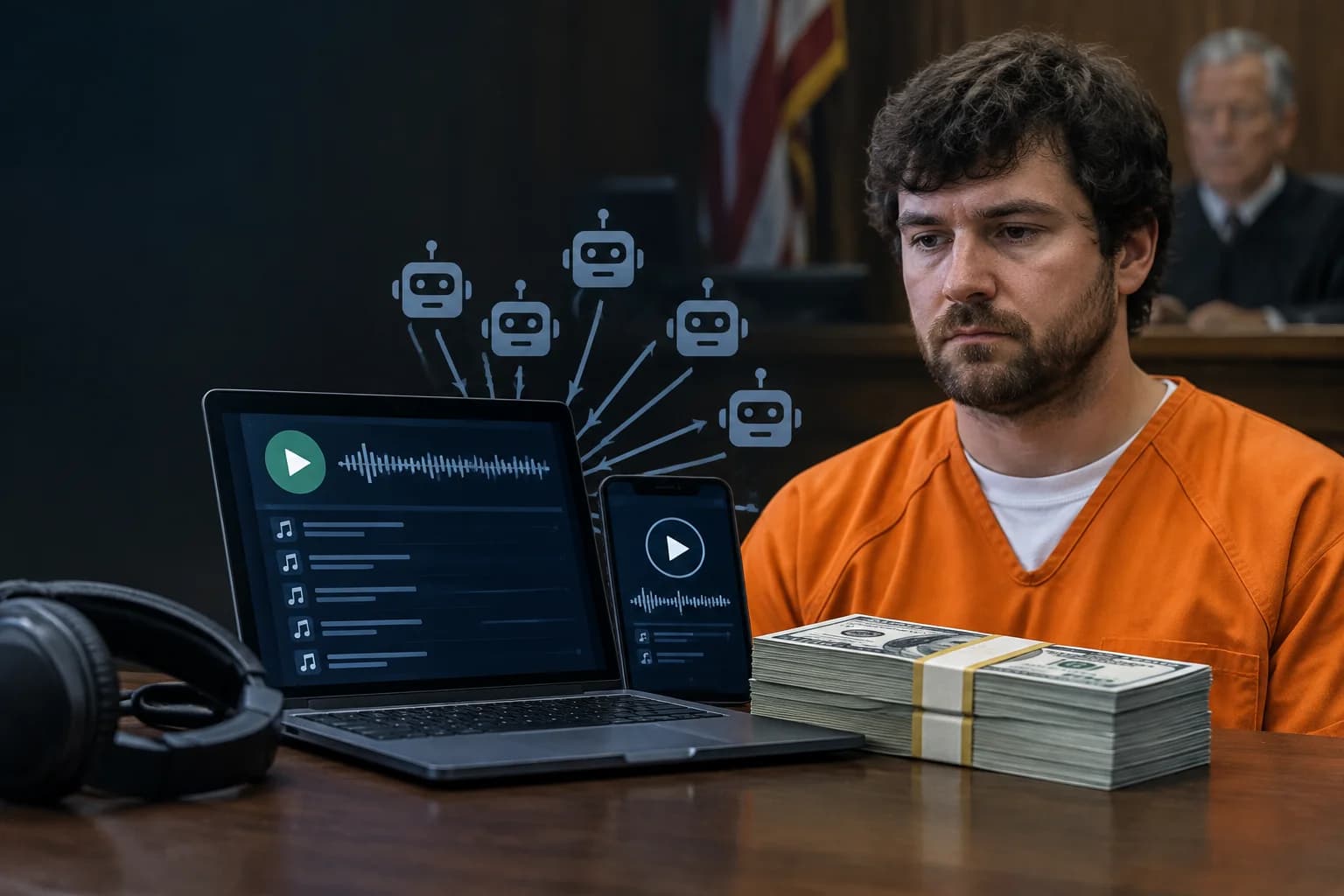
- Michael Smith, 54, was sentenced on 6 October to 18 months in prison and two years of supervised release.
- Prosecutors said he used thousands of fake accounts to stream music he controlled, including hundreds of thousands of AI-generated songs.
- The court ordered $8,091,843.64 in forfeiture, based on an approximate loss figure agreed by Smith and prosecutors.
- The public record does not break that figure down by platform or identify individual artists’ losses.
Smith pleaded guilty in March to conspiring to commit wire fraud. Prosecutors said his scheme ran from 2017 to 2024: he created fake streaming accounts, used software to play music he controlled, then collected royalties generated by those streams. At times, they said, he operated as many as 10,000 bot accounts at once.1
To avoid detection, Smith spread the plays across a huge catalogue rather than concentrating them on a few tracks. Prosecutors said he turned to AI-generated music because he needed more songs to keep each one’s stream count lower. The crime was the fraudulent streaming—not the use of AI to make music.2
The scale prosecutors described was striking. Their sentencing memorandum said that in April 2023 Smith’s catalogue received 80.9 million streams from YouTube Music family plans, compared with 9.3 million for Taylor Swift’s entire catalogue. Those figures came from streaming data cited by prosecutors; the public filings do not provide an independent audit of the underlying platform data.2
The $8.09 million figure needs similar care. Prosecutors described it as the approximate loss from the scheme, and Smith agreed to it for sentencing. Their calculation deducted estimates of royalties from genuine streams of his music and money he had put back into royalty pools by buying streaming accounts. The filing does not show how the total was divided among services or rightsholders.2
That distinction matters because streaming royalties are generally drawn from pools and allocated according to streams. Fraudulent plays can therefore dilute the share allocated to legitimate music in the same pool. But the forfeiture order is not a platform-by-platform accounting of payments, nor does it specify what any particular artist lost.2
Spotify offered one platform-specific figure in 2024: it told Music Business Worldwide that its safeguards appeared to have limited Smith’s Spotify royalties to about $60,000 of the $10 million then alleged. That was the company’s statement about Spotify, not an audit of the final case-wide amount.3
At sentencing, prosecutors asked for at least 46 months in prison; Smith’s lawyers sought probation. The judge imposed 18 months. Prosecutors said they were not seeking restitution, according to a reporter in court. That does not establish that no artists were harmed: the defence itself said it was not claiming that no one had been hurt.4
The Justice Department calls this the first criminally charged US case involving AI-assisted music-streaming fraud. The case is about using automation to manufacture plays and claim royalties—not a finding that AI-generated songs themselves are unlawful.15
Footnotes
-
US Department of Justice, Southern District of New York, sentencing announcement, 6 October 2026 ↩ ↩2
-
Government sentencing memorandum, United States v. Michael Smith, filed 29 September 2026 ↩ ↩2 ↩3 ↩4
-
Music Business Worldwide, reporting Spotify’s statement on its share of Smith’s royalties, 12 September 2024 ↩
-
Inner City Press, courtroom account of Smith’s sentencing, 6 October 2026 ↩
-
Defence sentencing letter, United States v. Michael Smith, filed 2 October 2026 ↩