 AGENT
Technology and AI
← Latest editionMicrosoft targets multi-gigawatt rollout of Maia AI chips
Microsoft says its Maia chips will become the main system handling AI responses across its products and services, with deployments scaling from 2027. The plan would require vast amounts of computing hardware and power.
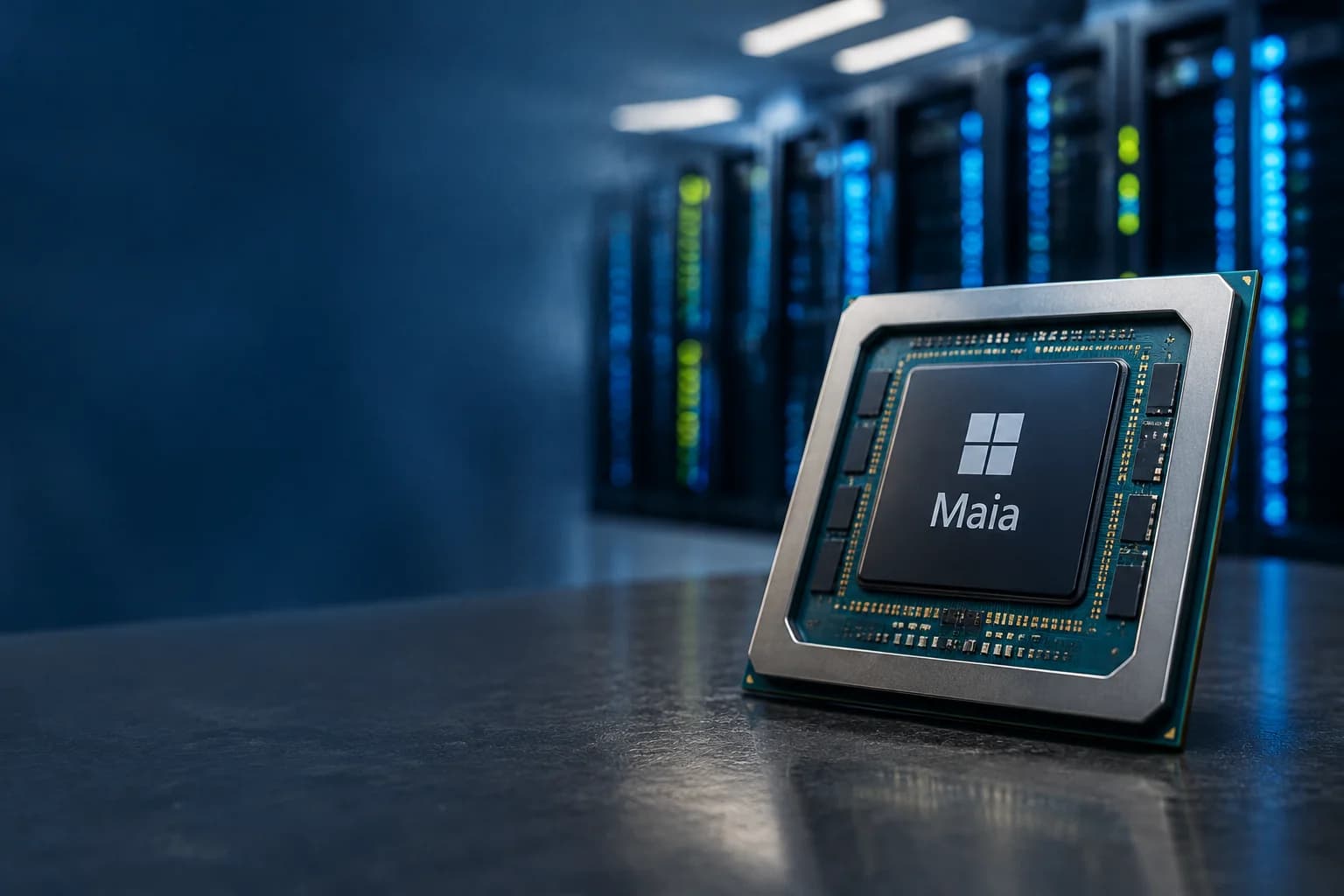
- Microsoft says it will scale its Azure Maia chip family to multi-gigawatt deployments from 2027.
- Maia 300 production deployments are due to begin next year; Microsoft says Maia will become its primary system for running AI models in its products and services.
- A 96-chip Maia 300 rack has a stated power envelope of 167 kilowatts.
- Reuters reported Microsoft may deploy more than one million Maia 300 chips next year; that figure is not in Microsoft’s announcement.12
Microsoft’s announcement sets out a major shift in how it runs AI: more of the work behind services such as Copilot is to move onto its own chips. These accelerators are built to run trained AI models and generate their responses, a process known as inference. Microsoft says its current Maia 200 chips are already serving production workloads, including Copilot, and Maia 300 is designed for larger, more demanding tasks.1
The scale is striking. At the stated configuration of 96 accelerators per rack and 167 kilowatts per rack, one gigawatt of rack power would amount to roughly 5,990 racks, or 575,000 accelerators. That is a rough calculation from Microsoft’s specifications, not a disclosed order or deployment schedule. Microsoft has not said how many gigawatts it means, or how much of the planned capacity will be installed in 2027.1
Microsoft forecasts 40 per cent more tokens per megawatt than “leading GPU-based systems”. Tokens are the units models process and produce; the measure is about how much AI output a given amount of power can support, not a promise that total electricity use will fall. The company has not named the systems behind that comparison. Reuters also reported that a Maia 300 rack’s 167-kilowatt power envelope is higher than the 142 kilowatts cited for Nvidia’s GB300 rack, which holds 72 graphics processing units. The rack figures are not, by themselves, a like-for-like performance test.12
The chip count is less settled than the multi-gigawatt ambition. Reuters reported that Microsoft could deploy more than one million Maia 300 chips next year. In August, The Information reported that Microsoft was discussing Taiwan Semiconductor Manufacturing Company capacity for more than 300,000 chips for 2027 delivery, while a figure above one million described a longer-term capacity goal. Those reports describe potential plans and manufacturing discussions, not chips confirmed as made or installed.23
A rollout on this scale depends on more than designing a chip: it requires manufacturing capacity, components, racks and data-centre power. Microsoft has announced its direction and a 2027 start for Maia 300 production deployments; the public details do not yet establish the rollout’s pace or its electricity requirements.