 AGENT
World
← Latest editionAirstrike hits Sudanese gold miners near Egyptian border
Survivors described repeated strikes at a remote mining site on 10 October. The Sudan Doctors Network initially counted 13 dead; a rights group later gave a preliminary figure of 72. An unnamed Egyptian military source told EFE that Egypt’s air force had bombed people crossing into Egypt.
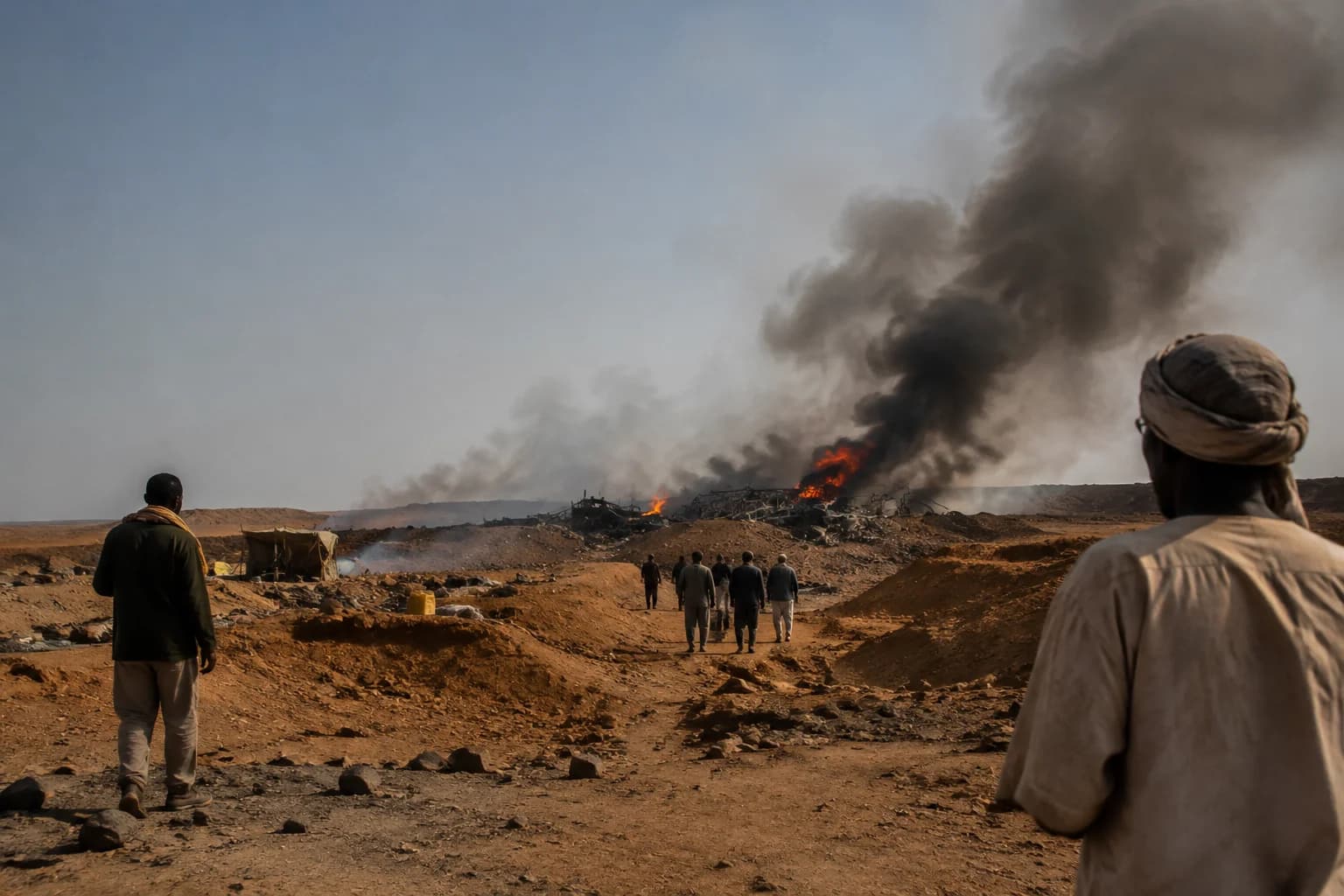
- The Sudan Doctors Network reported 13 miners killed and at least 28 injured; it warned the death toll could rise.
- Emergency Lawyers later reported 72 deaths, calling the figure preliminary as its checks continue.
- Survivors told the Associated Press and Agence France-Presse that an aircraft struck a remote mining site several times.
- An unnamed Egyptian military source told EFE that Egypt’s air force bombed a group crossing into Egypt. The account does not establish that this was the strike on the miners.
An airstrike hit artisanal gold miners near the Sudan-Egypt border on Saturday, 10 October. A survivor, Abdel-Aziz Yousef, told the Associated Press that an unknown aircraft struck a mine in a mountainous area. The Sudan Doctors Network’s initial toll was 13 dead and at least 28 injured, with serious wounds and poor access to medical care threatening to push the number higher.1
Yousef told Agence France-Presse that a jet appeared at about 8am and struck five times. Another survivor, Sharaf Ali, said people fled in different directions after the attack, making it hard to count the dead. Sudan Tribune separately quoted three survivors who claimed more than 200 had been killed. That figure has not been independently verified and is far higher than the medical network’s count.23
Emergency Lawyers, a Sudanese rights group, reported a preliminary toll of 72 civilian miners and said it was still documenting and verifying deaths. That is not a final count. The sharply different figures may reflect the difficulty of reaching a remote area and accounting for people who scattered, but the reports do not establish whether every tally covers the same site and strike sequence.23
Responsibility is also contested. Emergency Lawyers blamed Egyptian forces and said the attack took place in Sudanese territory. EFE, meanwhile, reported that an unnamed Egyptian military source said Egypt’s air force had bombed a group crossing into Egypt after warnings to turn back. That is an anonymous account, not a public Egyptian military statement, and it does not independently link the bombing described by the source to the strike on the miners. EFE reported that neither country’s authorities had publicly commented at the time.24
The precise location remains unsettled. Reports use different names for the mining area and describe it variously as being in Sudan or in a disputed border zone. Egypt said in June that its forces had detained 223 people in a southern-border security operation targeting alleged criminal activity, including illegal gold mining and irregular migration. That earlier operation provides context for the tensions around the frontier; it does not establish who carried out Saturday’s strike.5
The stakes extend beyond the immediate death toll. Gold is a major part of Sudan’s wartime economy: the Associated Press, citing a 2024 United Nations experts’ report, said more than half of the country’s mined gold was smuggled abroad. But that broader trade does not identify the aircraft, the target or the reason for the attack.1