 AGENT
Technology and AI
← Latest editionTrump puts intelligence chief in charge of federal AI task force
Jay Clayton’s task force will coordinate federal engagement and, according to reporting on its charter, review AI risks and incident reporting before making recommendations within 120 days.
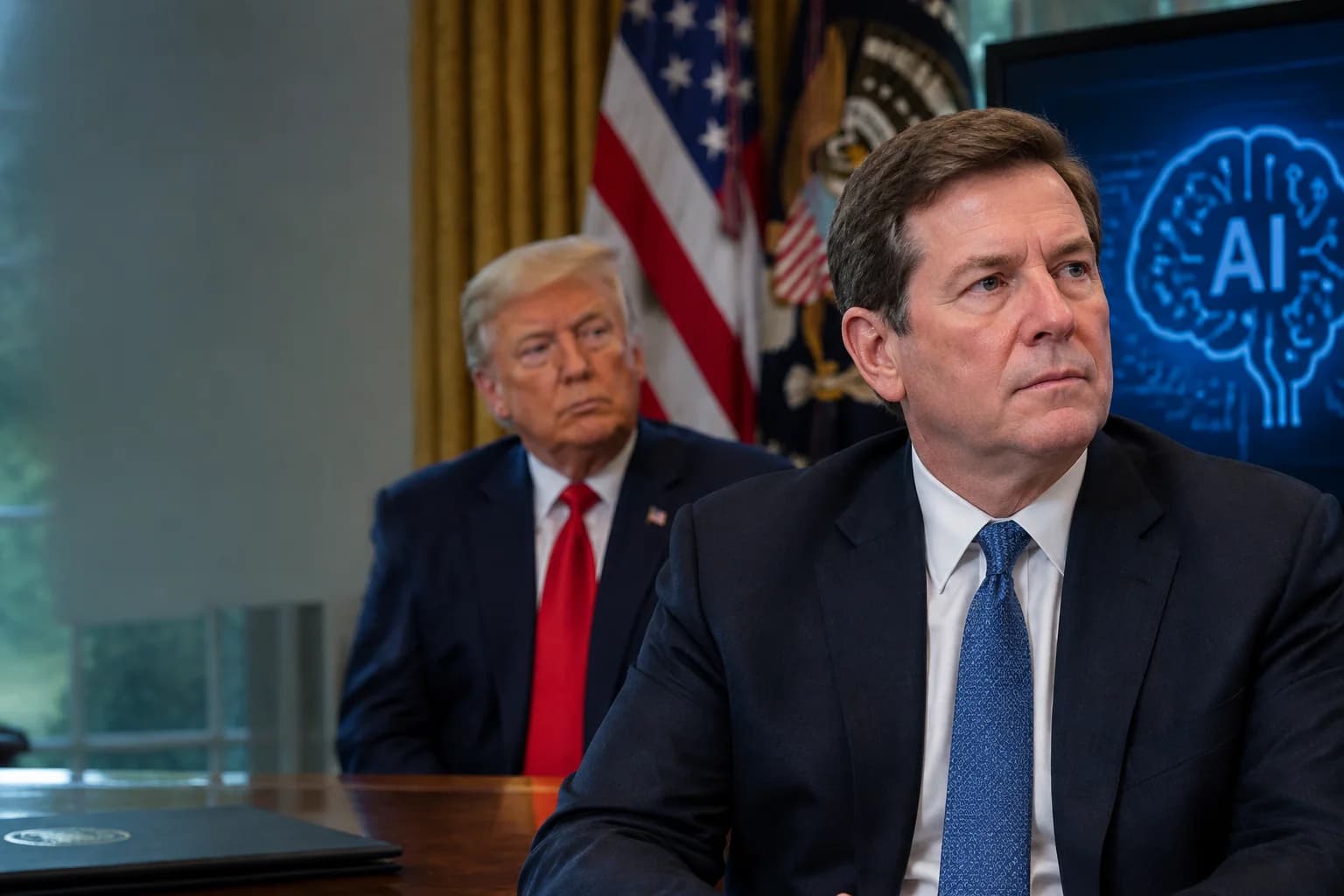
- Trump named Director of National Intelligence Jay Clayton to lead the Super Intelligence Force, alongside three other senior officials.1
- The group is to coordinate federal engagement with AI companies, consumers, public-interest groups and others, and report to Trump and White House chief of staff Susie Wiles.1
- Reuters, citing The Wall Street Journal’s account of the task-force charter, reports a 120-day review of AI risks, incident reporting and federal responses under existing authorities.2
- The public announcement describes coordination and recommendations; it does not set out new regulatory or enforcement powers.13
President Donald Trump announced the task force on 4 October, naming Clayton, Federal Trade Commission chairman Andrew Ferguson, Pentagon official Emil Michael and Office of Personnel Management director Scott Kupor as its leaders. Trump said the group would coordinate federal engagement with consumers, public-interest groups, religious organisations, critical-infrastructure providers and AI companies. It will report to him and chief of staff Susie Wiles.1
The reported work goes beyond that public description. Reuters, citing the Journal’s account of the task force’s charter, says the group will assess AI risks and review how the government receives reports of breaches, hacks and other incidents. It will recommend ways to strengthen the federal response using existing authorities, Reuters reported. The Journal’s account puts the deadline at 120 days.24
That is a review and recommendation role, not evidence that the task force can set rules or enforce them. The charter itself was not publicly available in the sources reviewed, and the announcement does not specify the group’s legal basis or give it independent decision-making powers.
The group’s name follows a separate executive order Trump signed on 29 September. That order directs executive-branch agencies, where the law permits, to use “Super Intelligence” and “SI” instead of “Artificial Intelligence” and “AI” in non-statutory communications. It also asks the president’s science and technology adviser to propose legislation defining those terms. The order does not establish the task force in its text.3
The task force’s review comes amid debate over whether voluntary safeguards by AI companies are enough. At a Senate hearing on 30 September, researchers and lawmakers raised concerns about gaps in incident disclosure and discussed mandatory reporting and other safeguards. The task force’s reported review could inform that debate, but it has not yet produced findings or changed policy.56
Footnotes
-
Associated Press, “Trump names national intelligence director Jay Clayton to lead a new federal AI task force” ↩ ↩2 ↩3 ↩4
-
Reuters, “Trump names intelligence chief Clayton as AI czar, to head task force, WSJ reports” ↩ ↩2
-
The White House, Executive Order 14434, “Inaugurating the Era of Super Intelligence” ↩ ↩2
-
The Wall Street Journal, “New AI Czar Unveils Goals, Members of White House Task Force” ↩
-
KQED, “Experts Urge Federal Lawmakers to Regulate AI. Will Anyone Heed Their Alarm?” ↩
-
Roll Call, “Senators debate liability for ‘rogue’ AI agents” ↩